The problem
Handling personal data compliantly is mostly manual work. Someone has to know which tables hold personal data, remember the lawful basis for using it, and chase down every copy when a person asks to be forgotten. I wanted to see how much of that could become software: clean APIs and a simple interface that make the compliant path the easy path. Consentinel is the result: a data-governance portal I built solo, end to end.
Approach
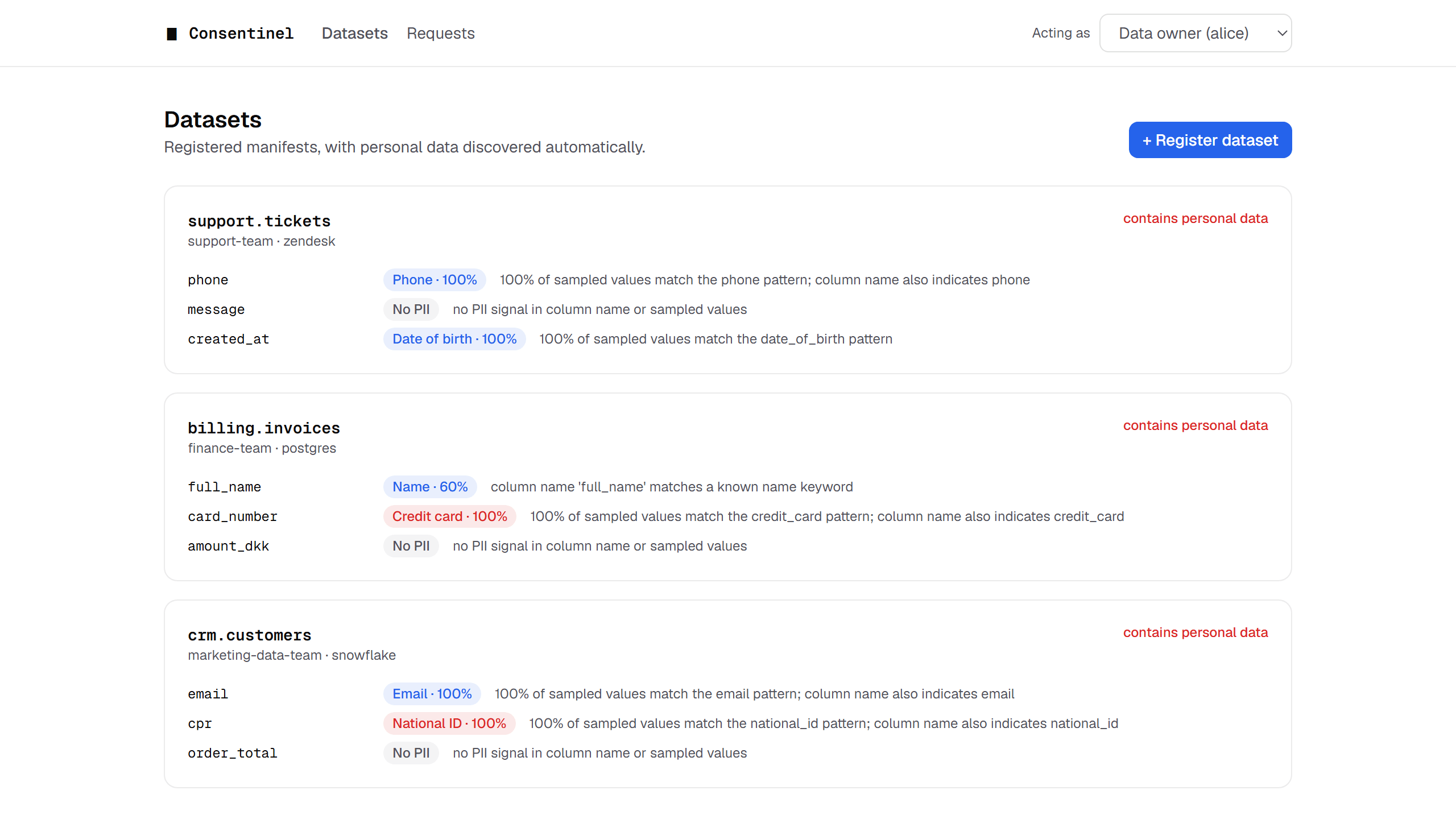
The system is organised around the real workflow of a data-platform compliance team. A data owner registers a dataset manifest; the API automatically classifies every column for personal data; the owner attaches a lawful basis (GDPR Article 6) and a retention period; and a data subject can file a right-to-be-forgotten or access request that moves through a stewarded approval workflow (pending → approved → completed), with every action recorded in an append-only audit trail.
Architecture
- Compliance API (Python / FastAPI / SQLAlchemy): the manifests, usage agreements, governance requests, and audit endpoints. It runs on SQLite for zero-setup local development and PostgreSQL for the containerised stack: the same code, swapped by one environment variable.
- Automatic PII classification: a dependency-free classifier that combines value patterns (regex, Luhn checks for card numbers) with multilingual column-name hints (English and Danish, including the Danish CPR national-ID format), and returns a category, a confidence score, and a human-readable rationale for every decision.
- Governance & secure access: role-based access control (owner / steward / subject / admin), the right-to-be-forgotten workflow with guarded state transitions (invalid transitions return a clean
409), and an immutable audit log. - Infrastructure as code: the whole stack comes up from
docker-compose(PostgreSQL + LocalStack), with Terraform provisioning an S3 evidence bucket and an SQS request queue, and Alembic migrations applied automatically on boot. - Dashboard (Next.js / TypeScript / Tailwind): a typed API client proxied through Next rewrites (so there is no CORS to manage), with a role switcher that lets you experience the app from each governance role and watch the access rules enforce themselves.
How I built it
I delivered it in SCRUM-style sprints, each one leaving the project in a working, tested state and landing as a single commit, so the git history reads like a delivery log. Every push runs a CI pipeline (ruff + pytest for the API, vitest + build for the UI, terraform fmt/validate for the infrastructure). The data-engineering core, the PII classifier, is deliberately pure and deterministic so it is trivial to unit-test and could run as a batch step over a whole catalogue.
What I'd do differently
The header-based access control is a deliberate stand-in for real OIDC/JWT auth, isolated in a single module so a real identity provider can replace it without touching the rest of the app; that is the natural next step. The PII classifier is heuristic, which is a strong first pass, but messier real-world data would benefit from complementing it with statistical or ML-based detection.